
CCTV survey: $300–$750
Stands alone and is credited against the works by most operators. Without it nobody can price a liner honestly.
We camera the line first, show you what is actually wrong, and then tell you whether relining is the right answer. Often it is. Where the pipe has collapsed or lost its fall, it is not, and we will say so rather than sell you a liner that disappoints.
Relining is a structural repair, not a cleaning method, and the distinction matters when you are comparing quotes. Jetting restores flow through a pipe that is still cracked. A liner restores the pipe.
That also means it is not always the answer. It cannot correct a run that has sagged or lost its fall, and it has nothing to line against where a section has collapsed. A camera survey separates those cases in about an hour, and the answer changes the cost by a multiple.
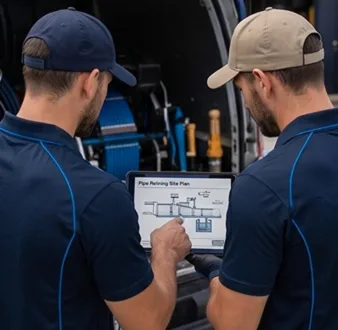

Most of the suburb went in during the 1960s and 70s on earthenware. Those joints have had six decades to open, and each one is an invitation to roots and silt.
Houses of this era were generally drained in vitrified clay, laid well, and then left alone for sixty or seventy years. The pipe is usually still round and still sound. The joints have had seven decades of ground movement and root pressure.
That combination is close to the textbook relining case, which is why so much no-dig work in Sydney happens on streets built between the late 1940s and the 1960s.
Rock close to the surface meant original lines were laid shallow, so they sit where roots travel and where ground movement and traffic loads reach them.
Reactive clay soil moves with the seasons, lifting in the wet and shrinking back in a dry spell. Rigid drainage laid through it gets flexed every year, and the joints are where that movement is absorbed until they stop absorbing it.
It is the reason drainage faults on these soils cluster after a long dry followed by heavy rain. The pipe did not fail that week; it finished failing that week.
Land that drops sharply toward Middle Harbour sends stormwater through private pits at speed, and anything undersized or half-blocked surcharges across the yard instead of taking it away.
Ground near water holds more of it, sits lower and moves more through the seasons than ground further up. Pipework laid decades ago has been flexed by that movement for its whole life, and joints open a fraction at a time rather than failing all at once.
It is why faults here tend to arrive as a slow decline rather than a sudden break, and why a camera often finds a run that is uniformly tired instead of one obvious defect. That pattern suits a full-length liner rather than a patch.
This is the honest limit of the method. A liner follows the pipe it is cured inside. If the run has sagged into a belly or lost its fall, relining seals it and leaves the shape exactly as it was, so the water still pools where it pooled before.
Killarney Heights (postcode 2087) sits high above Middle Harbour with Garigal National Park wrapped around its northern and eastern edges, bordered by Forestville, Seaforth and Davidson. Steep blocks falling away to bushland, sandstone close to the surface and largely original 1960s and 70s plumbing shape almost every drain problem here.
On sloping ground that failure mode is common enough to check for specifically. Where the profile is wrong, the correct answer is excavation and re-lay of that section, and we will tell you so even though it is the more expensive quote.
An open joint leaks in both directions. On a low-lying block that means stormwater and groundwater entering the sewer through cracks, which is called infiltration, and it quietly overloads a line that would otherwise cope.
It shows up as a system that backs up in wet weather and behaves perfectly in dry. If that is the pattern, sealing the run is the fix, and no amount of clearing will reproduce the result.
Very few homes of this age are still on their original layout. A second bathroom, a kitchen moved to the other side of the house, a granny flat out the back: each addition was joined into a system sized for the original plan.
The junctions where those additions were cut in are a common failure point, and they are worth looking at specifically. Relining handles a poor junction well, provided the camera has found it first.
A crack that opens in summer and closes in winter produces a fault that comes and goes, which is maddening to diagnose and very easy to dismiss as bad luck.
A liner is continuous through the affected length, so seasonal movement no longer has a joint to work on. On reactive ground that is the difference between a repair that lasts and one that reappears the next dry summer.
Stands alone and is credited against the works by most operators. Without it nobody can price a liner honestly.
The usual Sydney range for domestic sewer. Access and junction reinstatement are normally quoted separately.
One defect in an otherwise sound run. The proportionate answer on stable ground, and the wrong answer on a line with twenty tired joints.
Where the camera shows the same failure repeating along the length. Ends the problem rather than relocating it.
The honest comparison. Cheaper on an open lawn, rarely cheaper under a driveway, paving or a building.
Indicative Sydney ranges for 2026. Your job is quoted in writing after the camera survey. Figures here are indicative of the 2026 Sydney market rather than a quote from us, you get your own number as a fixed price before any work starts.

A CCTV survey establishes the material, the diameter, where the defects are and how far they sit from the access. You see the footage, and it is what the quote is built from.
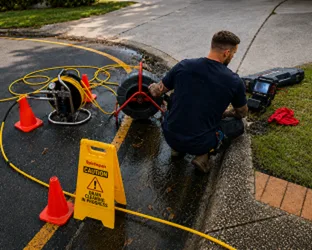
Patch or full length, and occasionally excavation instead. We will tell you when digging is the better answer even though it is the bigger quote.
The run is jetted so the liner bonds to pipe rather than debris, the liner is installed through the existing access, and it cures in place. Most domestic jobs are a single day.

Every branch the liner passed is reopened from inside, then the run is cameraed again so you can see it is continuous and the junctions are clear.
Send it through and we will come back with what it is likely to be, what the survey costs, and whether relining is even the right conversation.
Straight answers on price, durability and when to dig instead.

Ring us or leave your details. You will get a time for the inspection, not a price invented over the phone.

Leave your details and our local Killarney Heights team will call you back fast.